


Although the reality is more complex, it can feel like AI went from experiment to everyday infrastructure overnight. Many teams now have models, inside both customer-facing applications and internal tools, which lean on AI to drive automation and make decisions about data and access.
As those systems evolve and change how teams approach cybersecurity, more questions arise about who owns AI risks and how to keep behavior aligned with the rules you set. AI governance platforms give you a way to define clear policies and govern how AI behaves across your environment, in a form you can also show to auditors or regulators.
In this article, we’ll explain what AI governance platforms are, how they support security and compliance, and how to choose one for your organization.
What Are AI Governance Platforms?
AI governance is the set of policies and controls that guide how your organization designs and runs AI systems. In particular, these guidelines help you stay aligned with your risk tolerance and AI ethics commitments.
Most AI governance strategies begin with rules for which data you allow into training pipelines and who signs off on high-impact models. You’ll also define how your team should handle bias and alignment with AI frameworks, such as the NIST AI Risk Management Framework (AI RMF) or the EU AI Act.
AI governance platforms are the tooling layer that turns those policies into actionable workflows. These platforms give you one place to define AI policies, track where models and data come from, enforce access controls, and monitor live systems for issues like bias or shadow AI use.
Quality platforms will also combine policy management with lifecycle oversight and automated enforcement. In addition, they’ll plug into your data stack and identity systems, so governance becomes part of your day-to-day workflow.
Why Are AI Governance Platforms Important?
Without an AI governance tool, it’s harder to keep up with constantly changing models. AI governance platforms can:
- Detect and reduce ethical bias: AI governance tools evaluate models for unfair patterns in inputs and outputs, then surface issues so you can retrain or change how a model is used before it harms users or your reputation. That monitoring spans machine learning (ML) systems and newer generative AI (GenAI) models, and supports your broader ethical AI efforts as those systems scale.
- Promote transparency and accountability: A strong AI governance solution records who trains and deploys each model, what data they use, and how decisions change over time. During security audits or regulatory reviews, that combination of explainability features and audit trails makes it easier for technical and non-technical stakeholders alike to understand why a system behaved a certain way.
- Protect data privacy: AI governance platforms tie models back to regulations and internal policies they must follow, whether that’s the General Data Protection Regulation (GDPR) or the Health Insurance Portability and Accountability Act (HIPAA). By centralizing controls for data access and consent, you can prove that your models stay compliant with privacy requirements.
- Track performance and risk: Modern AI governance platforms watch for GenAI risks like drift and unsafe behavior in production, rather than treating model validation as a one-time event. Some platforms also pair governance with AI threat detection, watching for abuse patterns in how models are called or integrated into applications.
- Unify oversight: As more teams experiment with different models and services, AI governance software gives you a single inventory of AI systems and how they’re controlled. That centralized view makes it easier to spot unapproved tools or shut them down if they create too much risk.
8 Top AI Governance Platforms
Here are some top AI governance tools that you can map to your own regulatory pressure and internal maturity, and decide whether they fit alongside other AI cybersecurity tools in your stack.
1. Credo AI
Credo AI focuses on AI model risk management and policy enforcement, providing a central place to store AI metadata and governance reports aligned to regulations like the AI RMF. This helps you compare in-house systems and third-party AI security vendors against the same standards, so you can show how each model stacks up against internal rules and external obligations.
2. Holistic AI
Holistic AI takes a lifecycle view of AI governance, from use case scoping through deployment and monitoring. This platform builds an inventory of AI systems, then tracks how they line up with evolving regulations for high-risk systems and large language models (LLMs).
3. Monitaur
Monitaur's platform is built for teams that treat AI models like other regulated decision systems. This tool emphasizes continuous monitoring, bias and drift detection, mitigation workflows, and a “policy-to-proof” approach that turns high-level governance goals into evidence you can show to auditors.
4. Azure Machine Learning
Azure Machine Learning is Microsoft’s managed ML environment with built-in responsible AI capabilities. Data teams can build and monitor models inside Azure, then layer on explainability and governance features without leaving the primary toolset.
5. Lumenova AI
Lumenova AI positions itself as a responsible AI governance platform with strong coverage for GenAI risks. It offers libraries of tests, risk assessments, and workflows to help you evaluate models (including private LLMs) across different business units and regulatory frameworks.
6. Fiddler AI
Fiddler AI focuses on explainability and observability for ML and LLMs. It provides model explanations along with bias and drift tracking. Fiddler AI also gives you dashboards that translate complex behavior into views that business and risk stakeholders can understand.
7. FairNow
FairNow is technically a governance, risk, and compliance platform, but it includes AI-specific features. This platform inventories internal and vendor AI systems, maps them to legal and operational risks, and uses AI agents to generate documentation and bias reports.
8. Domo
Domo comes from the analytics world, but it’s moved into AI governance to let you register and manage external models inside its existing data platform. This aspect of Domo’s toolset focuses on secure model registrations and controlled access to providers like OpenAI, as well as dashboards that show where AI is used and how it performs across teams.
How to Choose an AI Governance Platform
Before choosing AI governance software, you’ll want to clarify which risks you care about and who needs to work inside the platform day-to-day. To figure out what platform is right for your team, you can:
- Start with concrete governance goals: Decide whether your priority is regulatory compliance, data privacy, ethical use, or GenAI system monitoring.
- Check how well the platform fits your stack: Look for integrations with your data warehouses, machine learning operations pipelines, model registries, and identity providers, so the AI governance tool can pull real signals rather than relying on manual uploads.
- Prioritize monitoring and explainability: Strong AI governance platforms should log who changed what and when, along with how models behave over time (including alerts for bias or performance shifts in production). This information helps you answer hard questions from regulators and internal risk teams.
- Consider accessibility: An AI governance solution that confuses product owners or compliance teams will likely end up ignored. Look for interfaces that non-specialists can easily navigate, and vendor support that responds quickly when something goes wrong.
- Plan for growth and change: Your AI footprint will shift as you add new models and regulations. Choose a platform that scales with higher volume and adapts to new rules and model types, without forcing you into a rebuild every year.
Improve Your AI Governance With Legit Security
Legit Security turns AI governance from a policy document into something your engineers feel in their daily work. Our AI-native application security platform gives you end-to-end visibility into how AI shows up in your software supply chain, from code assistants and MCP servers in the IDE to pipelines that train or deploy models. Then it ties that activity to risk, so you can see where governance gaps sit across apps and teams.
From there, Legit enforces governance policies in real time across development environments. VibeGuard and the MCP server sit next to AI code tools and CI/CD to block unsafe AI-generated changes, protect code and dependencies, and monitor compliance and risk exposure for AI-driven applications as they evolve.
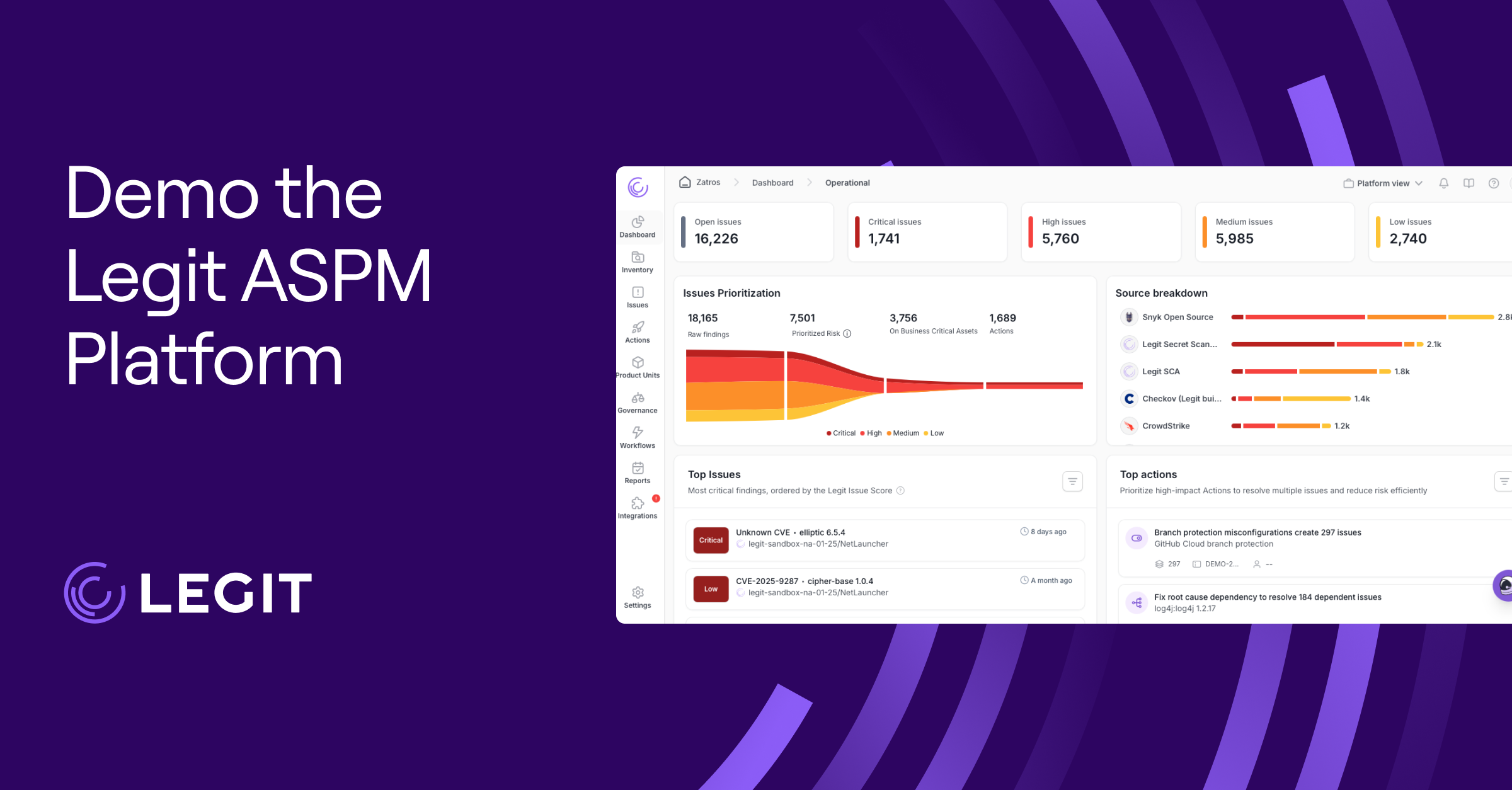
Request a demo today, and see how Legit Security wires AI governance directly into development and delivery.
Download our new whitepaper.