


Application security has spent a decade getting brilliant at half of its job. This is about automating the other half – starting with the fix, and not stopping there.
Ask any AppSec team where their pipeline breaks and almost none will say detection. We are very good at finding vulnerabilities. Static analysis reads every commit, software-composition analysis watches every dependency, and secret scanners, infrastructure-as-code checks, and reachability analysis are prevalent. The result is a steady stream of findings and a never-empty dashboard.
While we’ve become highly effective at finding vulnerabilities, security teams still spend most of their time triaging, fixing, validating, and reporting on them. This is exactly the gap Legit agentic remediation is designed to close. It applies AI agents to automate AppSec work beginning with remediation and expanding across the broader software security lifecycle.
The challenge
Development is moving faster than ever because of AI. More code is written and shipped than human review was ever meant to handle and scanners flag all of it. The gap between what gets detected and what gets fixed becomes the defining problem of the AppSec practice. It’s a throughput gap rather than a tooling gap, and you cannot hire your way across it.
Every finding bottoms out in human work
Behind each row in a AppSec dashboard is a series of manual steps that hasn't changed in years. A security engineer triages the finding and decides whether it's real and whether it matters. A developer is handed the ticket, and has to reconstruct the context the scanner threw away (e.g., what the code does, why it's shaped this way, what depends on it, what breaks if it changes). They write a fix, run the tests, open a pull request, and wait for review.
That chain is slow, and it is linear. It runs at the speed of human attention and ability, one finding at a time, while the scanners produce findings in parallel and around the clock. The arithmetic only ever goes one way: the backlog grows faster than people can drain it, and the highest-risk issues sit and age because they're also the ones that take the most care to fix.
The work doesn’t stop at the fix
And remediation is only the loudest part of the challenge. The same teams are also writing status reports for leadership, assembling evidence for the next audit, mapping controls to frameworks, opening and chasing tickets in the tracker, and hand-rolling the metrics that prove the program is working. Every one of those tasks is its own manual, context-heavy chain, and every one of them competes for the same scarce attention that the backlog already monopolizes.
Why “just point an AI agent at it” isn’t the answer
The obvious move, in this moment, is to hand the backlog to a general-purpose AI coding agent and let it write patches. While it is the right instinct, it is the wrong tool, because a generic agent is missing everything that makes security work safe:
- It has no security context. It doesn't know what's reachable, what's exploitable, or what actually runs in production, so it can't tell a real risk from noise.
- It has no security expertise. It doesn’t understand secure coding practices, common vulnerability patterns, or what a safe fix looks like in your stack. The result may be patching a symptom while leaving the root cause exposed, or introducing a new flaw in the process.
- It acts on anything you point it at. Effort and tokens get spent on findings nobody will ever ship, instead of the ones that matter.
- It never proves the work landed. It writes a diff and stops. Nothing re-scans, nothing confirms the finding is gone, nothing checks for regressions.
- It leaves no lineage. You get a patch with no thread back to the finding, the owner, the commit, or the runtime, so it can't feed a report, an audit, or a metric.
In other words, a generic agent stops at “here’s a patch.” The hard part of application security lives in everything around the patch — the context, the prioritization, the validation, the paper trail — and that's exactly the part a coding assistant can't see.
Closing this gap needs agents that own the context around the code, not just the code itself.
What we built: Legit Agentic Remediation
Legit’s agentic remediation, part of our Agentic AppSec platform, is built from agents that do automate these time intensive and expensive practices. Under the hood sit Legit agents: a centralized AI service and interface that executes structured tasks on behalf of users, workflows, and APIs – agents that triage, remediate, and report on application security. Every AI-driven action in the platform flows through one execution and governance layer. That layer decides which agent to run, gives it the right skills and prompt, enforces guardrails, draws on memory of what it has learned before, runs the task, and validates the result.
Security teams browse the catalog and turn an agent on. Legit leads with the work that carries the largest backlogs and the clearest path to automation – remediation of SAST and SCA findings – with more agents joining the catalog over time.
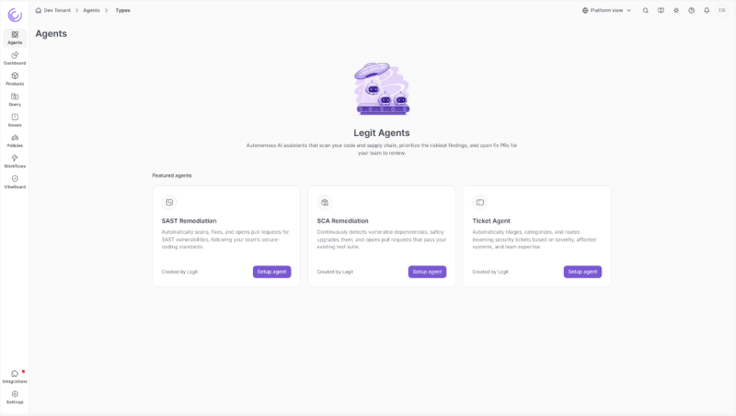
The Legit Agents catalog — browse available agents and turn one on with a single click.
The loop that makes it security-native
What separates these agents from a coding assistant is the loop they run, and the context they own at every step:
- Context. Every finding is enriched with what makes it actionable, including repo, owners, deployment, business impact, surrounding code patterns, and reachability signals.
- Prioritize. Reachability and exploitability scoring, organization-wide false-positive memory, and business impact from the SDLC graph strip the noise, so only confirmed risk surfaces. Legit understands security best practices and surfaces recommendations on which issues to address first, while giving teams full control over which issues agents work on and how they’re prioritized.
- Security expertise, embedded. The agent doesn’t just write code, it reasons about secure-by-default patterns, understands the vulnerability class it’s fixing, and validates that the fix addresses the root cause. AppSec knowledge is built into every step, not bolted on after.
- Remediate. The agent reads, plans, fixes, and pushes a context-aware fix that matches your code, delivered as a pull request for the developer to review and approve, routed to the right owner with an explanation of what changed and why.
- Validate. It re-scans and confirms the finding is closed, with no regressions and no new findings. Every result feeds back into the agent's memory, so the next fix is sharper than the last.
Seeing it work
Activating an agent opens its workspace with a live view of everything it's doing. The board tracks each unit of work from Backlog to In Progress to Pending Approval to Completed. Every card is a real vulnerability the agent has picked up, for example, command injection in a CLI handler, a server-side request forgery in a webhook service, or an XML external entity flaw in a report parser. The process moves steadily toward a merged pull request, with its automation and guardrails configured right alongside.
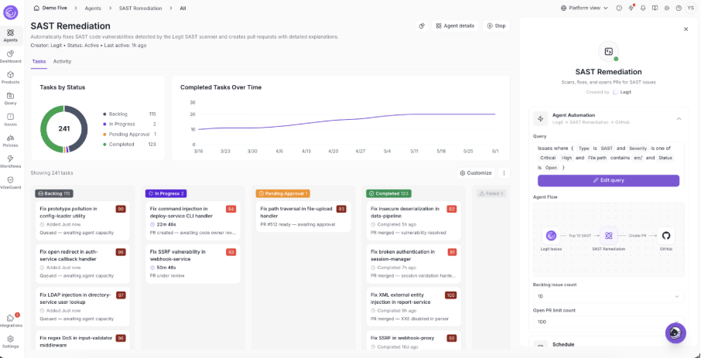
The SAST Remediation agent at work: a live board tracking each vulnerability from backlog to a merged pull request.
How teams use it
The experience is built around a few end-to-end flows with automatic agent work first, human interaction second:
- The agent fixes and opens a PR on its own. Context, plan, fix, self-verify, and then a pull request routed to the right code owner, who reviews and approves the change before it merges, with the full activity log visible in the workspace.
- Or you send it work directly. Select findings from the issues list and dispatch them straight to an agent.
- You can talk to it on the PR. Ask questions, request changes, push back. The agent answers in-line and refines the fix, and every exchange feeds its memory.
- And it stays accountable. Every agent action (read, write, model call) is captured for audit, with guardrails and approval gates throughout.
Back to the gap
If you recall everything a generic agent was missing, Legit’s security-native agent closes each one of these gaps. It owns the context, so it knows what's reachable and what runs in production. It acts only on what matters, because prioritization comes first. It validates end-to-end, so work isn't done until the finding is provably gone. And it keeps full lineage – finding to task to pull request to commit to runtime – so the result is audit-ready by default, and ready to feed the next agent down the line.
Remediation is the first step, not the destination
Remediation is where Legit Agentic AppSec starts, because it's the most painful and the most measurable. But the same agentic layer (context, governance, memory, and validation) extends to every other part of the practice that today runs on manual effort. The goal isn't a single clever fixer. It's an AI workforce for application security, where each task that used to demand a human now has an agent that can own it end to end:
- Triage and prioritization. Agents that confirm what's real, deduplicate, and rank by exploitability and business impact before anyone is paged.
- Remediation across the stack. Beyond SAST and SCA to secrets rotation, dependency upgrades, infrastructure-as-code fixes, and misconfigurations.
- Reporting and insights. Agents that draft executive summaries, surface trends, and answer questions in plain language for engineering and the board.
- Compliance and audit. Continuously collect evidence, map controls to frameworks, and keep the org audit-ready instead of audit-panicked.
- Ticketing and orchestration. Opening, routing, updating, and closing work in your tracker automatically, escalating to a human only when one is genuinely needed.
- Metrics and SLAs. Agents that compute program health, time-to-remediate, risk burndown, and coverage, and flag when an SLA is about to slip.
- Threat modeling and posture. Reasoning about new designs and changes to surface risk early, and tracking security posture as the codebase evolves.
- Policy and governance enforcement. Applying organizational coding standards and guardrails consistently across every repo.
- Custom agents you define. Describe a security workflow in natural language and stand up an agent for it, on your own terms.
Each of these shares the same foundation: Legit context, organizational prioritization, repo-specific guardrails, central logging, and a memory that compounds with every task. Over time that foundation becomes the AI control plane for application security — one layer through which every automated security action flows, with full visibility and control.
Legit doesn’t stop at “here’s a patch.” It lands at “actually fixed in production” — and then keeps going, across the whole of application security. It establishes Legit as the system that doesn’t just find what matters, but intelligently acts on it.