


When Security Incidents Break: The Questions Every CISO Asks (And How We Securely Built a Solution in Record Time)
It was an average Tuesday when React2Shell hit. Then Shai Hulud soon followed. Then came the flood of messages from security leaders asking the same questions: Are we affected? And if so – how?
For most organizations, answering these questions means investigative work: searches through SBOMs, emergency team meetings and hours or days of analysis to provide the Board and customers with definitive answers. In today’s software supply chain, where a single vulnerability can cascade through thousands of dependencies, the window between zero-day disclosure and active exploitation keeps shrinking.
At Legit, we responded quickly – and securely, by eating our own dog food.
TLDR: We built the Threat Feed fast using AI-assisted development – and secured every line of AI-generated code at the moment it was created using Legit VibeGuard.
Alert Fatigue is Real, but Real-Time Data and Actionable Context are the Material Gap
Threat feeds aren’t new. Nearly every security vendor has one. But what we’ve seen is most threat feeds are essentially glorified RSS readers. They tell you what happened and might tell you why it matters. But they rarely tell you the one thing that determines your security response: Does this AFFECT me? Right now. With evidence.
That’s the gap we set out to close. By tracking a multitude of sources, including NIST’s National Vulnerability Database (NVD), CISA’s Open Source Vulnerabilities (OSV) and the GitHub Advisory Database, among other real-time feeds, we identify relevant incidents as soon as they are disclosed.
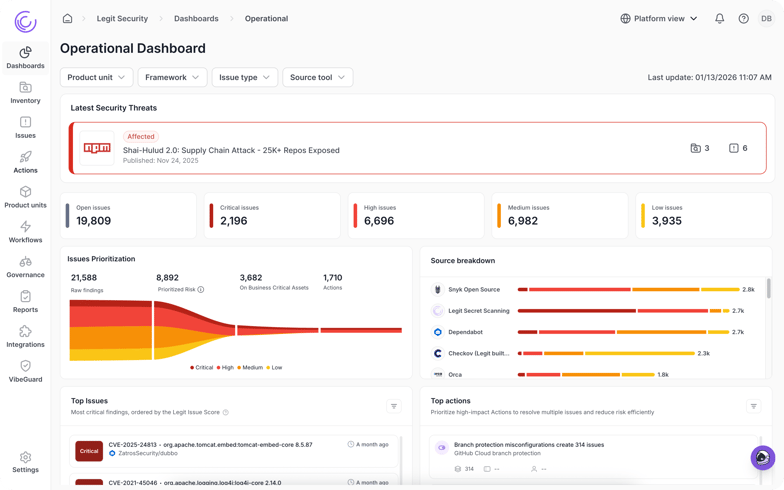
The Legit Threat Feed doesn’t just notify you about emerging threats; it automatically correlates them against your actual attack surface (dependencies, versions, configurations, runtime environments, etc.). We also go one step further, with specifics such as: “This vulnerability exists in these five repos, introduced during this build, owned by this team and evidence of patching exists here.”
When a new incident like React2Shell emerges, you don’t get a generic alert saying, “critical vulnerability in React ecosystem – please investigate.” Those are the answers that lead CISOs and their teams to spend hours investigating manually.
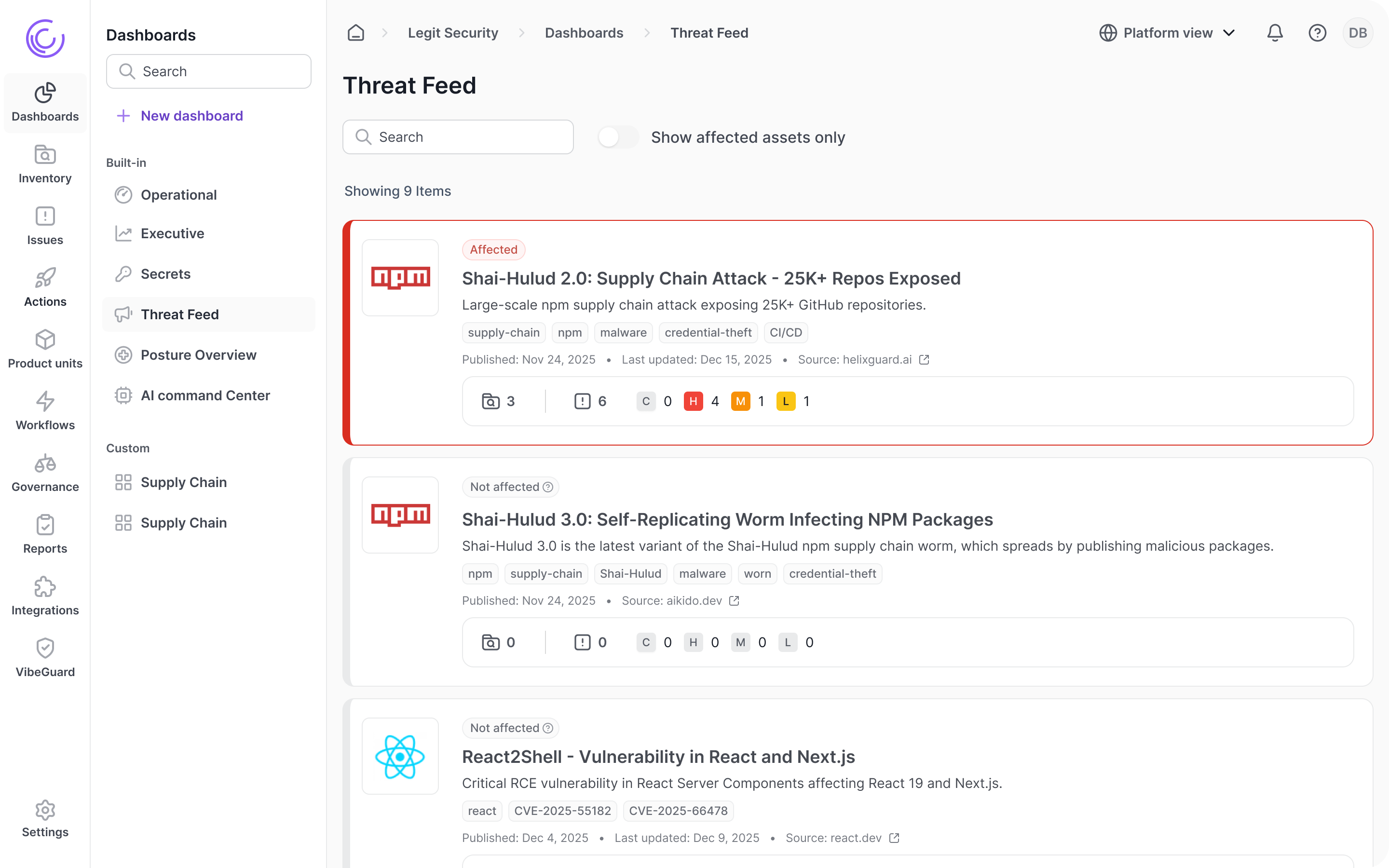
Instead, you get one of four defensible answers that can be brought to the Board or an executive leadership team:
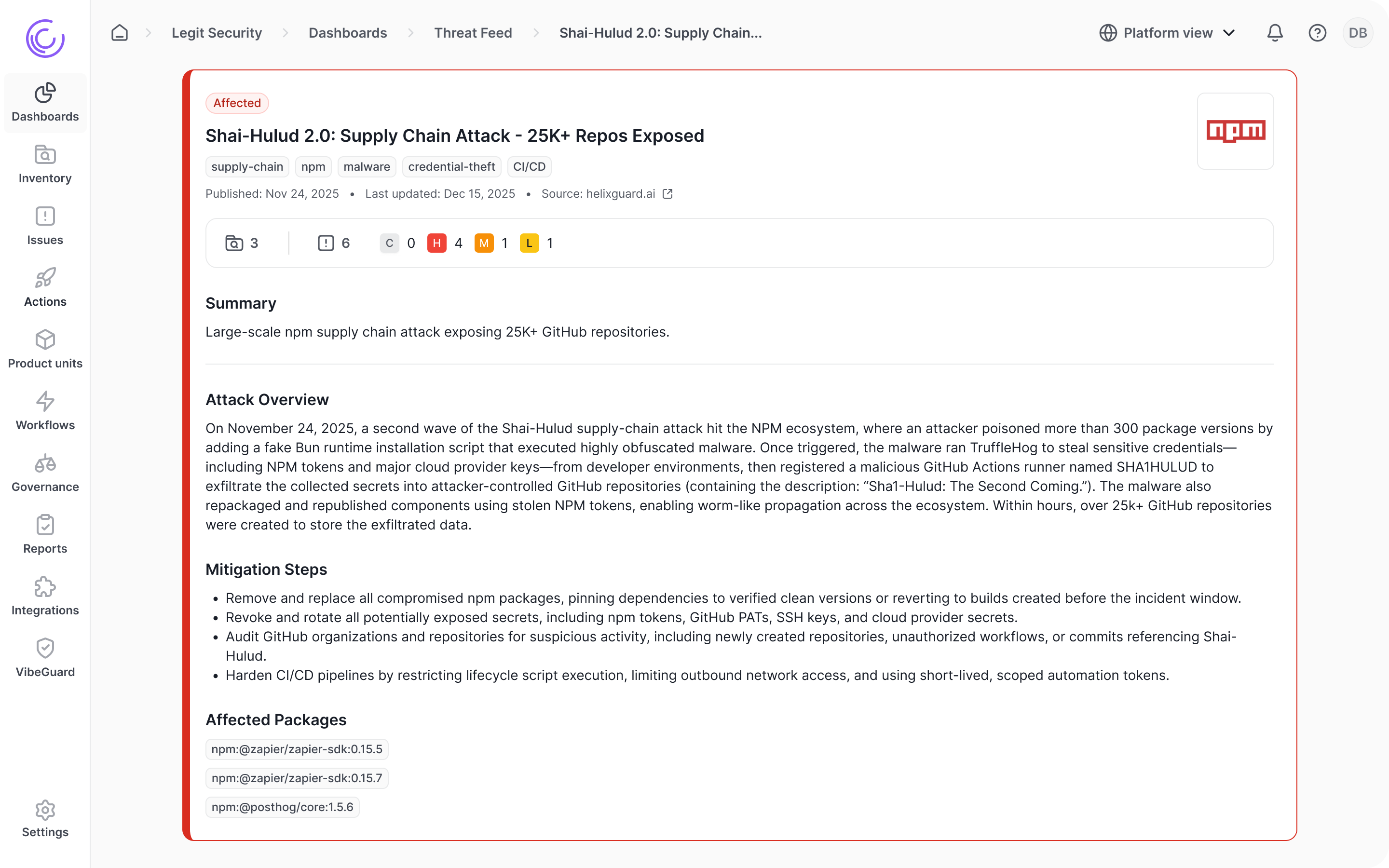
- Affected: We found the vulnerable dependency and version in your environment. Here’s exactly where, with links to the repos, build artifacts or container images.
- Not Affected: We scanned your entire supply chain. This threat isn’t present. And critically, here’s the evidence.
- Potentially Affected: We found the package, but we’re still correlating version information or analyzing reachability. Preliminary assessment suggests concern.
- Unknown: We’re still collecting data. We’ve prioritized getting you a definitive answer; please stand by.
Rather than generic recommendations, each answer comes specific evidence tied to your environment, along with links to the affected issues and mitigation guidance.
Beyond this, Legit’s ability to understand your broader software supply chain greatly enhances the benefits of the new Threat Feed. We analyze dependencies across your entire software supply chain – from declared dependencies to transitive chains, correlating against NVD, OSV, and other sources to give you comprehensive coverage.
In addition, it’s important to recognize that not every vulnerability is exploitable. With capabilities like reachability analysis, code to cloud correlation and API mapping, customers can analyze how risky the current scenario may be and save time by avoiding false alarms in situations that pose no material risk.
Built Securely at the Speed of Threats (Thanks to Vibe Coding and VibeGuard)
This situation above is the very one our customers see each and every day. A features wasn't on the roadmap six months ago but landed on engineers’ plates because of recent events and the evolving threat landscape. So, we needed to leverage the power of AI to produce a solution – immediately.
Our team built the Threat Feed fast using what every development team is leaning into today: vibe coding. By using AI coding agents (and tools such as Cursor and GitHub Copilot), we were able to move from ideation to production faster than traditional development processes would allow. This is exactly the kind of workflow that’s transforming software development velocity across the industry. It’s also exactly the workflow most security programs were never designed to govern.
But here's the catch with AI-generated code: speed without security creates new risks. Insecure patterns, prompt injection and secrets leakage all present real threats.
With that in mind, we integrated VibeGuard directly into our AI IDE across the entire company. Every line of AI-generated code was scanned in real-time. Issues were caught and fixed automatically, not in post-PR reviews, but at generation.
The result: The Threat Feed shipped fast and shipped secure.
What does all this mean? When the new Legit Threat Feed was delivered – thanks to the power of vibe coding – it was secure from day one thanks to VibeGuard. This is precisely why we built Legit Security in the first place. The same tools we use to help our customers secure their AI-generated code? We use them ourselves.
The Threat Feed is more than a feature; it’s proof of concept. It demonstrates that you can move fast with AI-assisted development and maintain security rigor. You just need the right guardrails.
From Detection to Response in One Platform
The real power of the Threat Feed becomes apparent when you see it in context of the broader Legit platform. When an incident is marked as “Affected”, the links don’t just show you what is vulnerable; they drop you directly into the remediation workflow.
You can see exactly which repositories contain the vulnerable dependency, track which teams own them, verify patch status, and monitor remediation progress. All of this can be done without leaving the platform or opening a dozen different tools.
This is what we mean by closing the gap between detection and response. Not just telling you there’s a problem but putting you just a few clicks away from fixing it.
The Bottom Line
Every CISO we talk to says the same thing: “My team doesn’t need more alerts. We need clearer answers.”
The Legit Security Threat Feed is our answer. When the next React2Shell drops, you won’t be scrambling to figure out if you’re affected. You’ll know with evidence – immediately.
And because we built it using the same AI-accelerated development practices that our customers use every day – with the same security controls we help them implement – it’s also proof that speed and security aren’t mutually exclusive.
The next zero-day is coming. Will you have answers – or more questions?
See how the Legit Security Threat Feed works in your environment. And if you’re navigating vibe coding and AI-generated code today, we’re happy to share what we’ve learned or show you VibeGuard in action.